A complete data platform for batch and streaming, SQL and PySpark, BI and ML, powered by Spark and ClickHouse. Everything is code: one Terraform roll-out builds it from an empty cloud project, one command removes it again. I tested that for real by destroying and rebuilding the lab, then published it as open source under Apache 2.0.
lakehouse-lab: one Terraform command to destroy, one to rebuild, now open source
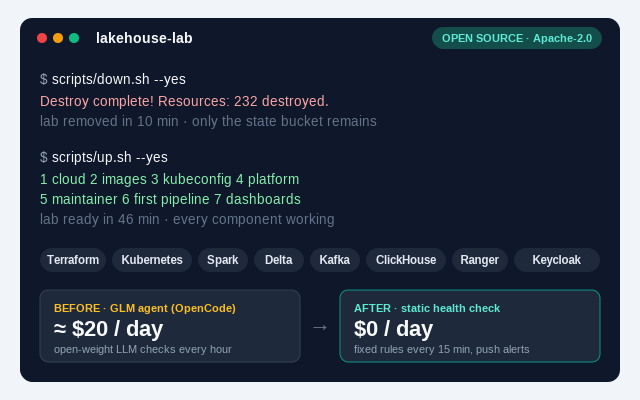
Terraform destroy and apply
The real test of “everything as code”: throw the whole platform away and bring it back. Between projects the lab is simply destroyed, so it costs nothing but a tiny state bucket.
What scripts/up.sh does (around terraform apply)
Seven steps, each with its own timing, idempotent: running it again continues where a failed run stopped.
| 1 | Cloud resources | terraform apply on the cloud module: project, IAM keys per workload, buckets with policies, secrets with generated passwords, container registry, Kubernetes cluster. |
| 2 | Images | Official releases downloaded and checksum-verified, platform images built for amd64 and arm64 without RUN steps. |
| 3 | Kubeconfig | Admin access to the new cluster; waits for the nodes. |
| 4 | Platform | Operators, Kafka, Spark, Kyuubi, Hive Metastore, Ranger, ClickHouse, Airflow, Superset, lldap, Keycloak, monitoring, plus setup jobs for users, rights and tables. |
| 5 | Maintainer account | A restricted Kubernetes account for operations tooling: sees everything except Secrets. |
| 6 | First pipeline | Runs a weather pipeline once through landing, bronze, silver, gold and consumption. |
| 7 | Dashboards | Superset datasets, charts, dashboards and roles, now that the data exists. |
What the rebuild taught me
Destroy must never hangKafka topics carry finalizers; when their operator is removed in the same step, the destroy waits forever. Fixed with the operator's documented setting plus a safety net in down.sh: the next destroy went straight through in 10 minutes.
New clusters have racesA just-started admission webhook can be unreachable for a few seconds. One automatic retry instead of a fragile wait.
No patchingOfficial releases and documented settings only. Where a gap remained (lldap to Ranger sync, a notebook magic for PySpark through Kyuubi) it is small, separate and documented as a deviation.
Nothing private in publicThe open-source copy is produced by a publish script with an exclude list and a deny list kept outside the repo: no domains, IP addresses or internal tooling leak.
Maintenance: open-weight LLM, then a static script
I let an AI agent look after the running lab: OpenCode with the open-weight GLM model, hosted in a European cloud.
The GLM agentEvery hour it checked pods, streaming and alerts, made simple repairs (restart a stuck pod, verify, report) and sent a push message. A daily root-cause analysis added improvement suggestions. It worked, but measured at about $0.70 a run it came to roughly $20 a day.
Optimised to a static scriptMost hours nothing is wrong, so an LLM is overkill. A plain Python health check with fixed rules now runs every 15 minutes and reports to the same push channel at no cost. The LLM is used interactively, when I decide it adds value.
Open source
Published under the Apache 2.0 license: gitlab.com/tigornl/lakehouse-lab-oss. The README covers the idea, principles and deviations, components, architecture, SSO and authorization, and step-by-step installation. Domains and secrets are yours to arrange.